

Lanolin protection
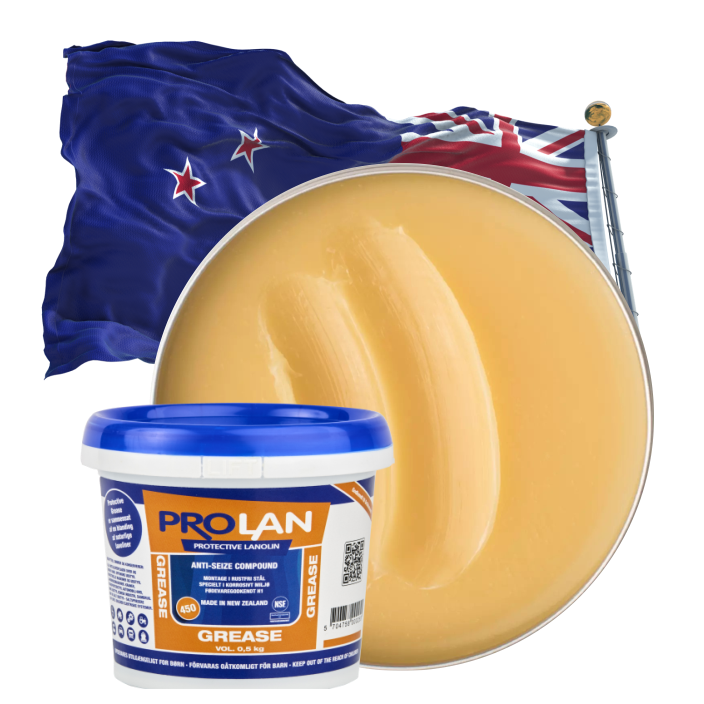
Lanolin — natural sheep's wool wax — is one of the most effective natural barriers against moisture and corrosion. ProLan combines lanolin with other natural ingredients to create protection that stays on the surface, doesn't run off and doesn't evaporate.
ProLan in practice
Video demonstration of ProLan lanolin protection.
How does lanolin work?
ProLan penetrates deep into the metal surface and creates a flexible, water-repellent layer. This keeps oxygen and moisture away from the metal, preventing rust from forming. Unlike traditional greases, bitumens and oils, ProLan stays firmly bonded for a long time and doesn't wash off with rain, seawater or cleaning agents.
Unique properties
Removes and prevents rust
Forms a long-lasting barrier against moisture and oxidation.
Water-repellent and UV-resistant
Ideal for outdoor use and extreme weather conditions.
Multi-purpose
Protects all metals, works as a release agent, resistant to chemicals and salt.
Environmentally friendly and safe
Free of harmful substances, biodegradable.
Safe for food and drinking water
ProLan is REACH-certified, holds NSF Food Approval, and has obtained the EUROFINS certificate for contact with drinking water. It is suitable for use on machinery and surfaces in the food industry as well as in drinking water systems.
Where can lanolin protection be used?
- Trucks, trailers and vehicle chassis
- Marine equipment, boats, engines
- Offshore platforms and ports
- Agricultural and garden machinery
- Machinery in the food industry
- Hydraulic systems and heavy machinery
- Electrical connections and connectors
- Household metal surfaces, garden tools, fences
Frequently asked questions
How do I choose the right ProLan?+
The right choice depends on the intended use. For cleaning, degreasing and removing old protection, use ProLan Medium 170 — it works like a light oil that penetrates crevices and prepares the surface. For standard metal protection under normal conditions, Heavy 270 is a good fit. For vehicles, agricultural machinery or equipment exposed to mud, salt and mechanical stress, we recommend Heavy Enduro 300, which forms a thicker film and offers greater resistance. For the toughest conditions — marine environments, offshore platforms, truck chassis — choose Extreme 350, which creates the densest and most durable barrier.
How is ProLan applied?+
ProLan is extremely versatile to apply. It can be applied with a brush for precision work, a roller for larger flat surfaces, an aerosol spray for quick repairs, or an airless sprayer for professional projects. Before application, it's advisable to clean and dry the surface, although ProLan also works on slightly damp or already rusted surfaces. Several thin coats provide better and longer-lasting protection than one thick coat. At low temperatures, the product can be slightly warmed to make it more fluid.
How long does it protect?+
The duration of protection depends on the chosen product, the thickness of application and the conditions of use. Under normal conditions, Heavy 270 protects for up to 2 years, while Extreme 350 can last 3 years or more even in extreme marine conditions. The easiest way to check is a visual test: as long as water droplets bead off the surface, the protection is still working. Once water starts staying on the surface and wetting it, it's time to reapply. Since ProLan is flexible, there's no need to remove it — a new layer can simply be applied over the old one.
Is it harmful to animals?+
No, lanolin is a completely natural and ethically sourced product. Sheep are shorn every year for hygiene and health reasons — otherwise the fleece, which contains lanolin, would become too hot and cause problems. Lanolin is then extracted from the wool by washing and harms neither animals nor the environment. The product is biodegradable, non-toxic to fish or plants, and is even certified for contact with food and drinking water (NSF, EUROFINS), proving its safety.